SGTP: Sampling-based Game-Theoretic Planning for Real-Time Multi-Vehicle Autonomous Racing

1 Zhejiang University 2 Nanyang Technological University 3 Technical University of Munich
contact: zh_li [at] zju [dot] edu [dot] cn

Teaser

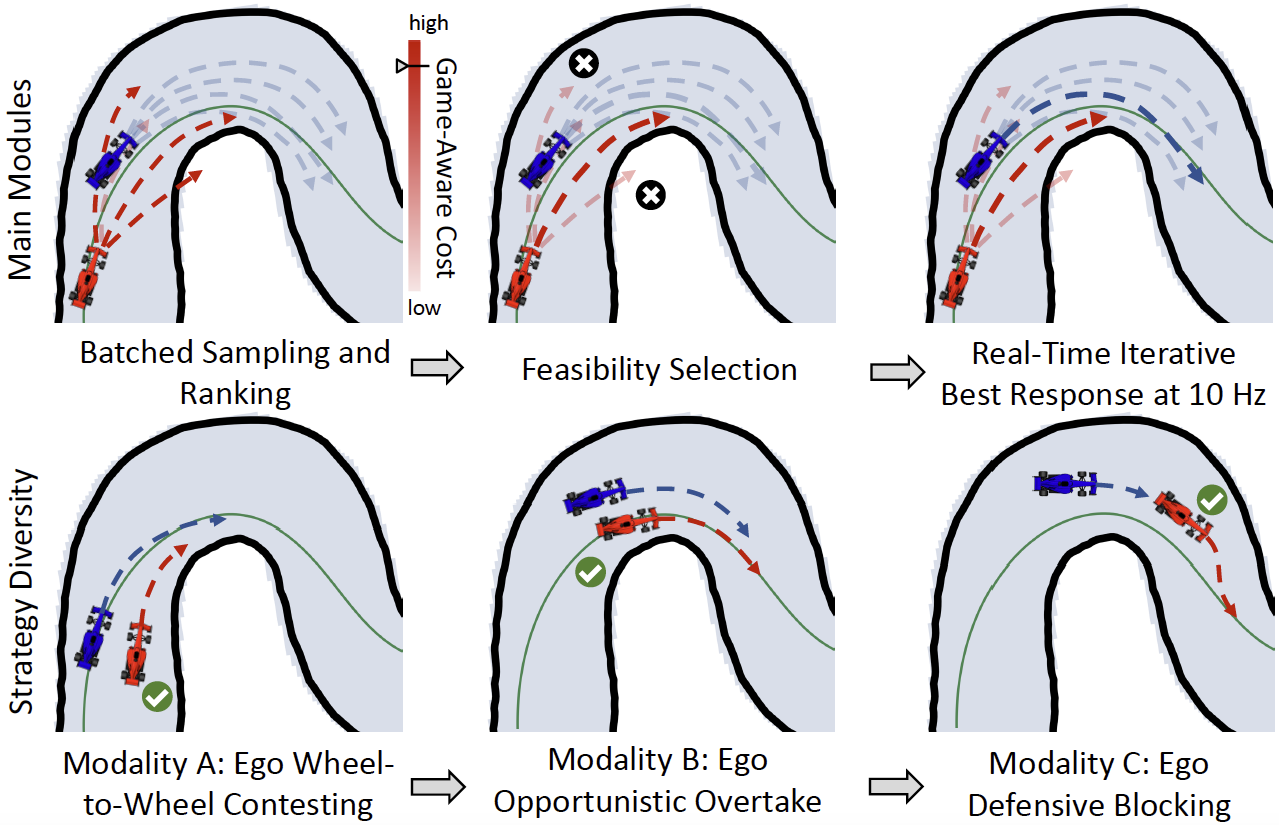
Proposed Sampling-based Game-Theoretic Planning (SGTP) framework for multi-behavior autonomous racing. SGTP combines GPU-accelerated sampling-based planning with game-theoretic best-response reasoning, using a new game-aware cost to favor competitive interactions and selecting the lowest-cost feasible trajectory.
Abstract

Autonomous multi-vehicle racing requires real-time planning of diverse competitive behaviors in intense interactions. Existing planners often struggle to balance strategic diversity and computational efficiency. To address this challenge, we propose Sampling-based Game-Theoretic Planning (SGTP), a real-time framework that combines game-theoretic reasoning with GPU-accelerated sampling of control sequences and dynamics rollouts. Sampled trajectories are ranked using a game-aware cost to capture competitive interactions and generate diverse racing behaviors. Our planner then performs feasibility selection by explicitly enforcing track-boundary and dynamic collision-avoidance constraints, ensuring safe and reliable transitions between racing strategies. Extensive simulations on challenging tracks show that SGTP achieves a 95.24% win rate and a 99.35% task-completion ratio in highly interactive races, with a mean computational time of 0.095 s over multiple iterative solving steps. We also demonstrate the successful application of SGTP in large-scale scenarios with up to 10 agents. We release our code and provide an open-source benchmark of multi-agent autonomous racing algorithms to facilitate future research.


Qualitative Evaluation of Multi-Behavior Interactions

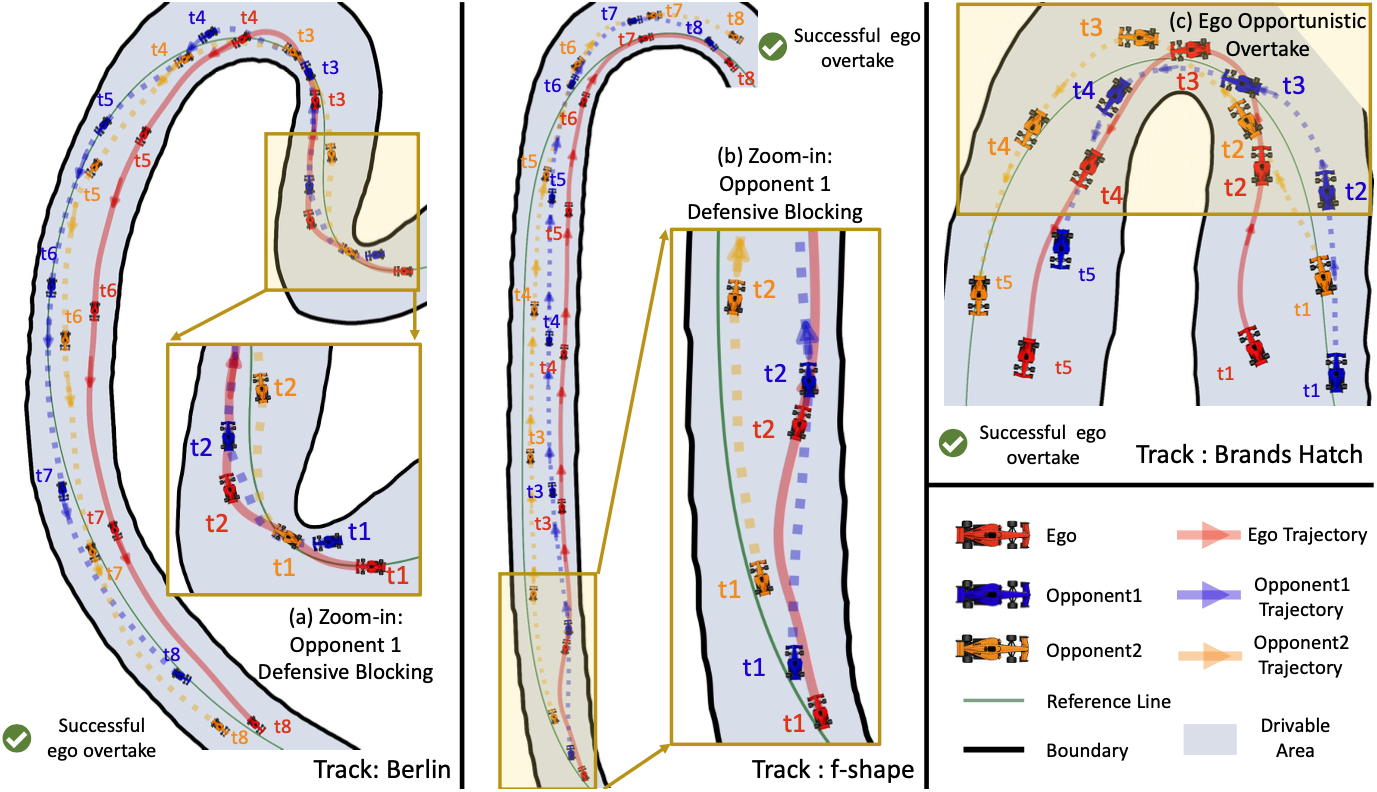
SGTP enables competitive behaviors and reliable transitions between them in highly interactive scenarios on multiple racetracks. The ego vehicle demonstrates diverse racing behaviors, including trailing and wheel-to-wheel contesting, before completing an opportunistic overtake after sustained close-range interactions.

Track f: Behavior A - blocked first, then three-car pass

Track BrandsHatch: Behavior B - opportunistic apex pass

Track f: Behavior A - blocked first, then three-car pass. Key moment: 4 s. The ego vehicle is first blocked by the blue car and then recovers to overtake three vehicles. replay
Track BrandsHatch: Behavior B - opportunistic apex pass. Key moment: 14 s. The ego vehicle identifies a short passing window near the corner apex and completes the overtake. replay

Track Berlin: Behavior C - defense-aware staged overtake

Track warehouse_v1: Behavior D - late block into side-by-side driving

Track Berlin: Behavior C - defense-aware staged overtake. Key moment: 7 s. The ego vehicle encounters successive defensive positioning from the blue and yellow vehicles. It adapts from trailing to sustained wheel-to-wheel contesting, progressively secures favorable racing corridors, and completes the overtaking sequence. replay
Track warehouse_v1: Behavior D - late block into side-by-side driving. Key moment: 20 s. The ego vehicle overtakes the blue and yellow cars; then the yellow car moves out to block, leading to a side-by-side interaction. replay

Adaptive Multi-Behavior Racing and Reliable Strategy Transitions

Track Berlin: Behavior A - corner-entry fallback

Track Berlin: Behavior B - mid-overtake fallback

Track Berlin: Behavior A - corner-entry fallback. Key moment: 10 s. The ego vehicle cancels an attempted pass when entering the corner and switches back to trailing behavior. replay
Track Berlin: Behavior B - mid-overtake fallback. Key moment: 7 s. The ego vehicle switches back to trailing in the middle of an overtaking attempt. replay

Track BrandsHatch: Behavior C - squeezing-assisted pass

Track f: Behavior D - blocked return to reference line

Track BrandsHatch: Behavior C - squeezing-assisted pass. Key moment: 12 s. The ego vehicle applies lateral pressure to create space and then completes the overtake. replay
Track f: Behavior D - blocked return to reference line. Key moment: 17 s. After being blocked by the yellow vehicle, the red vehicle returns to the reference line while the yellow vehicle keeps defending the side position. replay

Track f: Behavior E - persistent side blocking

Track MoscowRaceway: Behavior F - adaptive apex overtake

Track f: Behavior E - persistent side blocking. Key moment: 14 s. The yellow vehicle maintains a side-blocking position for an extended period. replay
Track MoscowRaceway: Behavior F - adaptive apex overtake. Key moment: 8 s. Near the corner apex, the red vehicle reacts to blocking by changing its overtaking line and completes an opportunistic pass. replay

Track Nuerburgring: Behavior G - straight-line feint

Track Nuerburgring: Behavior H - active lateral squeeze

Track Nuerburgring: Behavior G - straight-line feint. Key moment: 12 s. The red vehicle switches direction on the straight, feints past the yellow vehicle, and completes the overtake in the following corner. replay
Track Nuerburgring: Behavior H - active lateral squeeze. Key moment: 34 s. The red vehicle proactively applies lateral pressure to the yellow vehicle. replay

Track Oschersleben: Behavior I - repeated blocking

Track Oschersleben: Behavior J - opportunistic transition into the lead

Track Oschersleben: Behavior I - repeated blocking. Key moment: 1 s and 5 s. The blue vehicle blocks the red vehicle twice in succession. replay
Track Oschersleben: Behavior J - opportunistic transition into the lead. Key moment: 3 s. The blue vehicle identifies an immediate passing opportunity, completes the overtake, and transitions into the lead during the evolving multi-vehicle interaction. replay

Track Oschersleben: Behavior K - active safety-aware yielding

Track MoscowRaceway: Behavior L - side-by-side setup and second-apex pass

Track Oschersleben: Behavior K - active safety-aware yielding. Key moment: 4 s. When the available racing corridor becomes temporarily constrained, the red vehicle actively yields and maintains a feasible state rather than forcing further progress, demonstrating safety-aware behavior under close-range interaction. replay
Track MoscowRaceway: Behavior L - side-by-side setup and second-apex pass. Key moment: 32 s. The red vehicle follows through the first corner apex, drives side by side, and completes the pass at the second apex. The other two vehicles also leave the reference line and attempt to overtake each other. replay

Scalability Analysis Across Vehicle Counts

Multi-Agent Scalability Overview

Overview of SGTP scalability across multiple interacting vehicles

4 Vehicles replay

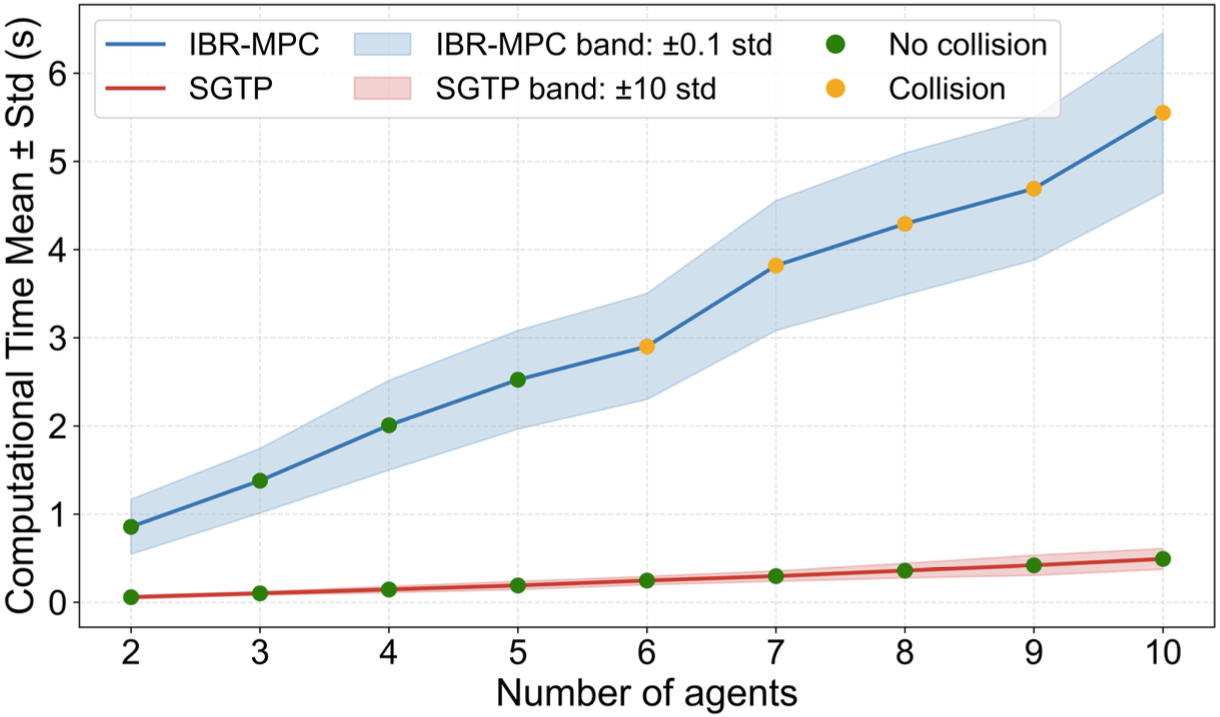
SGTP performance with an increasing number of interacting vehicles. The rollouts demonstrate SGTP in competitive multi-vehicle racing scenarios with four to ten vehicles. SGTP maintains low, consistent computation times and collision-free operation as the number of vehicles increases.

5 Vehicles replay

6 Vehicles replay

7 Vehicles replay

8 Vehicles replay

9 Vehicles replay

10 Vehicles replay


BibTeX


@misc{li2026sgtpsamplingbasedgametheoreticplanning,
  title={SGTP: Sampling-based Game-Theoretic Planning for Real-Time Multi-Vehicle Autonomous Racing}, 
  author={Zhouheng Li and Fangguo Zhao and Mattia Piccinini and Baha Zarrouki and Yuan Gao and Zitong Shan and Johannes Betz and Chen Lv and Lei Xie},
  year={2026},
  eprint={2607.25388},
  archivePrefix={arXiv},
}